Should a confidential messenger know the phone numbers?
Gologram does not have access to the phone book and does not know the phone numbers. Gologram is a truly confidential messenger.
Open communication without registration, without an account, without censorship, without servers and only online.
Secure communication without registration, without an account, end-to-end encryption with your key, without servers and only online.
Storing notes on the device in encrypted form, without registration, without an account, encrypted with your key, without servers.
Is it safe to register in the messenger, sync and log in to your account from any device?
There is no registration or synchronization in Gologram, and all saved chats can only be seen on your device if you save them. Gologram is a truly secure messenger.
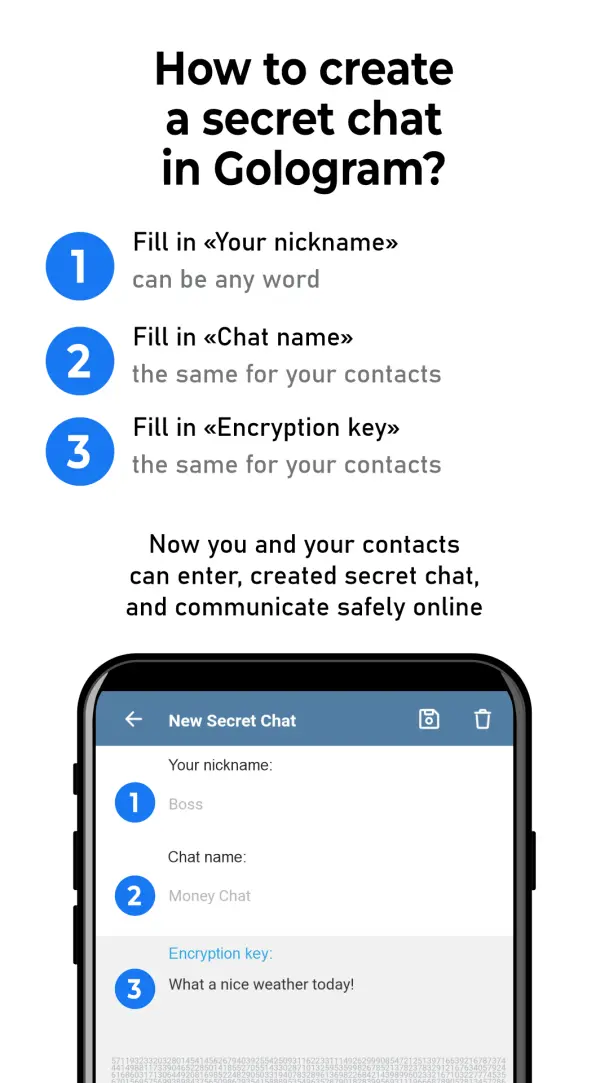
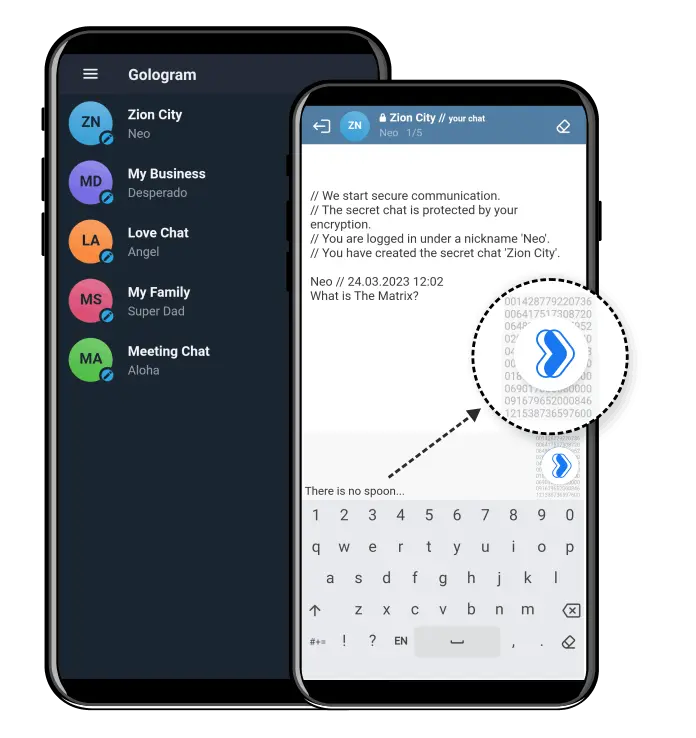
To start a Secret Chat, you need to:
1. Enter the same "Chat Name".
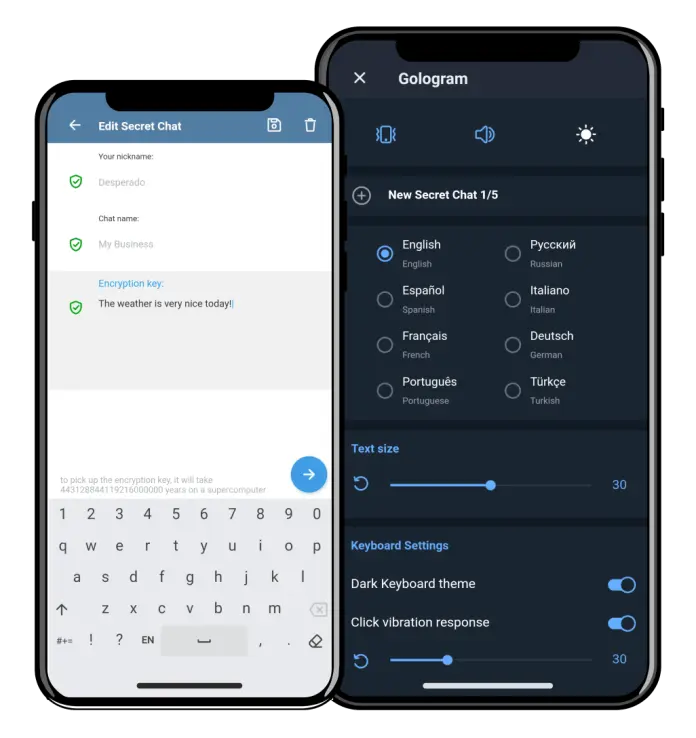
2. Enter the same "Encryption Key".
3. Chat together online to receive and send encrypted messages.
A Secret Chat is:
› Invented names without specifying phone numbers.
› Communication without servers is directly P2P and only online.
› Communication without registration, users are anonymous.
› Only those who are in a secret chat receive new messages.
› The message history is not forwarded to those logged into the secret chat.
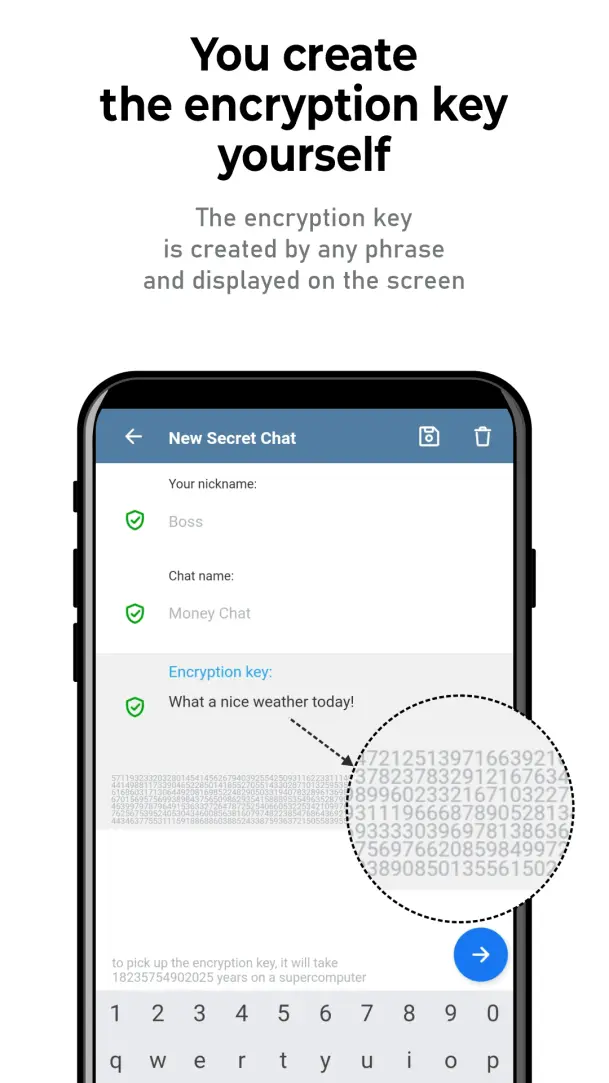
› The encryption key is created by the user and stored only on his device.
› Encryption without exchanging encryption keys.
› Messages are stored only on the user's device.
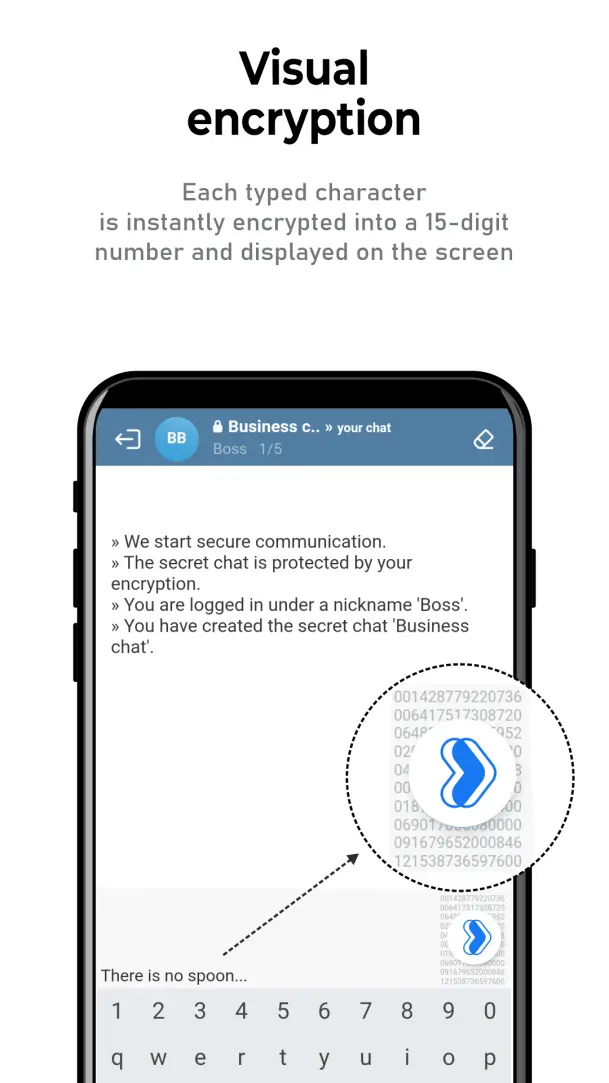
› The visual encryption of each character is shown on the screen.
› The phone numbers and contacts of the users are unknown.
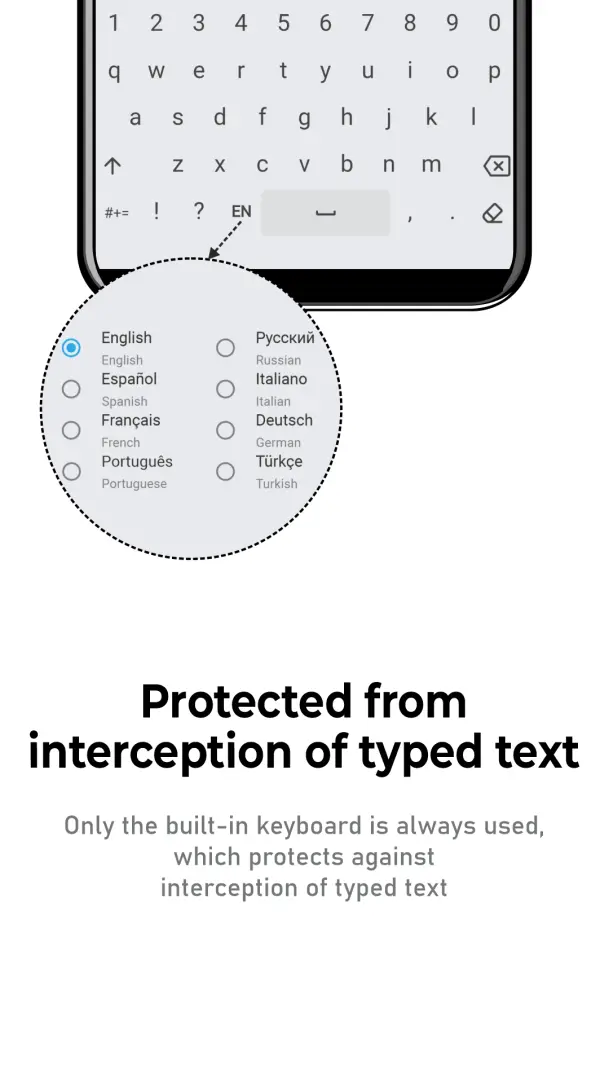
› There is no access to the gallery, camera, calendar, location, fingerprints, microphone, phone book and phone number.
› You can always see the number of participants and notifications about their entry and exit.
To create a Public Channel, you need to:
1. Enter any "Channel Name".
2. Enter any "Nickname".
A Public Channel is:
› Open communication for people all over the world.
› Communication without servers is direct and only online.
› Part of the message history is forwarded from the channel participants to the one who logged into the channel.
› Communication without registration, users are anonymous.
› The phone numbers and contacts of the users are unknown.
› An open communication channel without encryption, passwords and keys.
› The public channel is visible to everyone and is open for entry as long as there are free places in it.
› Messages are saved only on the user's device while he is in the public channel.
› By clicking on a user's nickname, you can block messages from them.
To create an Encrypted Note, you need to:
1. Enter any "Note Name".
2. Enter any "Encryption Key".
Encrypted Notes are:
› Encrypted storage is only on the user's device.
› The visual encryption of each character is shown on the screen.
› The encryption key is created by the user and stored only on his device.
› The encryption key cannot be restored.
To verify encryption and decryption, the user can enter an encryption key other than the correct one and make sure that the correct decryption does not occur.
Communicating in Public Channels, Secret Chats and storing Encrypted Notes without a phone number and without registration.
Using the encryption key created by the user with any phrase invented by him without the participation of the messenger.
Storing the history of Secret Chats and Encrypted Notes only on the user's device without servers and without logs.
Is it safe when a messenger creates an encryption key for you and stores it on its server with your messages?
In Gologram, the user himself comes up with and creates an encryption key that is stored only on his device along with his messages. Any phrase invented by the user turns into his encryption key. Gologram does not use servers for communication and for storing messages or encryption keys. Gologram is an anonymous and secure messenger.
1. Without registration - anonymously.
A messenger without a phone number, without an e-mail, without an account.
2. Zero access to the phone.
Without access to the gallery, location, fingerprints, camera, microphone.
3. Without servers and metadata collection.
Storing messages on the user's device, communicating only directly without collecting metadata.
4. Own encryption key.
The encryption key is created by the user himself with any phrase without the participation of the messenger.
5. Secure storage of the encryption key.
The encryption key is stored only on the user's device and is not sent anywhere.
6. Visual encryption.
The visual encryption of each character is shown on the screen and encrypted with the key that the user created.
1. With registration, it's not anonymous.
A phone number is specified or an account is created on the server.
2. Open access to the phone.
With access to the gallery, location, fingerprints, camera, microphone.
3. Metadata collection and storage.
Storing messages or collected user metadata on messenger servers.
4. Encryption with someone else's key.
To encrypt messages, an encryption key is used that was created by the application and not by the user.
5. The encryption key is being forwarded.
Part of the encryption key is sent over the Internet and possibly stored on the server along with the messages.
6. Blind encryption.
The user cannot verify how, when and with what his message is encrypted, or whether the message is encrypted at all before sending.
The number of possible options for selecting an encryption key is equal to the number of possible characters, taking into account the case and special characters (85 characters) to the extent equal to the key length.
For example, the number of possible options with a key length of 20 characters:
85^20 = 387 595 310 845 143 558 731 231 784 820 556 640 625
It's on 47 312 943 924 205 095 267 857 177 388 788 429 169 there are more options than a 128-bit encryption key:
2^128 = 340 282 366 920 938 463 463 374 607 431 768 211 456
In fact, if the length of the encryption key is unknown, then the number of possible options for selection will be many times greater. It will be equal to the number of variants of the minimum possible encryption key plus the number of variants of the next key, and so on.
For example, the number of encryption key variants with a length of 22 characters is equal to the number of key variants with a length of 17 characters plus the number of key variants with a length of 18 characters plus the number of key variants with a length of 19 characters and so on up to 22 characters.
To calculate the time required to select all possible encryption key options, it is necessary to divide the number of encryption key options by the number of key selection operations:
With an encryption key length of 20 characters, it will take time to select:
18 938 448 940 047 152 570 772 365 588 108 157 982 763 646 976 : 13 938 912 000 000 000 000 000 000 = 1 358 674 833 448 059 114 712 years old. That is, it will take 1 sextillion years (1*10^21)
During the typing of each new character, it is encrypted with the encryption key entered by the user and turns into a long number that is displayed on the screen.
For example, the message "Hello!" it may look like this:
"8814679, 1446081, 3296180, 9237003, 4604864, 1416393"
Or so:
"2398077, 2718759, 7334764, 4583744, 1937319, 2571267" or something else depending on the encryption key created by the user.
Therefore, it may take thousands of years on a supercomputer to decrypt a Gologram message.